
Faloxirenal
family enjoying cruise ship deck on a tropical voyage

Family Cruising

Everything a family needs to plan a cruise voyage that works for every age group on board.

Picture a holiday where the children are genuinely occupied, the adults have time to relax without orchestrating every hour, and the group arrives at each destination together with no logistics to manage between stops. Family cruising delivers that structure more reliably than most holiday formats — but choosing the right ship and itinerary for a multigenerational group requires a more deliberate planning process than booking for two adults alone. First, establish the age range of every traveller in your group, because onboard programmes and cabin configurations differ significantly between families with young children, families with teenagers, and three-generation groups. Next, identify which cruise lines invest meaningfully in family programming versus those that offer it as an afterthought. Finally, map your chosen itinerary against school holiday dates in Malaysia to confirm availability and plan your budget around peak-season pricing.
Talk to Us
Onboard Life

One of the most common misconceptions about cruising is that sea days are wasted days — time spent in transit rather than experiencing anything meaningful. In practice, the opposite tends to be true for travellers who approach sea days with the right mindset. Step one is understanding what the ship itself offers as a destination. Modern cruise ships are engineered to keep passengers engaged across extended periods at sea. The range of facilities available varies by ship size and category, but most contemporary vessels include multiple pool decks, fitness centres, a variety of dining venues, live entertainment spaces, and quiet lounges for those who prefer to read or socialise in a calmer setting. The daily programme — published each evening for the following day — maps out organised activities, deck parties, cooking demonstrations, trivia sessions, port talks, and evening performances. Working through the programme the night before and identifying two or three things you genuinely want to attend gives structure to the day without over-scheduling it. Step two is calibrating your expectations by ship type. A large resort ship offers the widest range of onboard options but also the largest crowd. If your preference is for a quieter pace, a mid-size or small ship delivers a more proportionate environment — fewer fellow passengers competing for pool deck chairs at the same time, a dining room that feels like a restaurant rather than a canteen, and a general sense that the ship is operating at a human scale. Step three is using sea days deliberately for the things that port days do not allow. A long breakfast without a schedule to meet, a full morning in the spa, an extended session in the fitness centre, or simply sitting on a balcony watching the ocean pass — these are experiences that port-heavy itineraries compress into the margins. Travellers who treat sea days as a genuine part of the holiday rather than a gap between destinations tend to disembark feeling more rested than those who treat every hour ashore as a productivity exercise. The rhythm of a well-balanced itinerary — alternating port days and sea days across a seven to fourteen night voyage — is one of the structural qualities that distinguishes cruising from other travel formats. It builds rest into the schedule without requiring you to book it separately.

Cruise Dining Explained

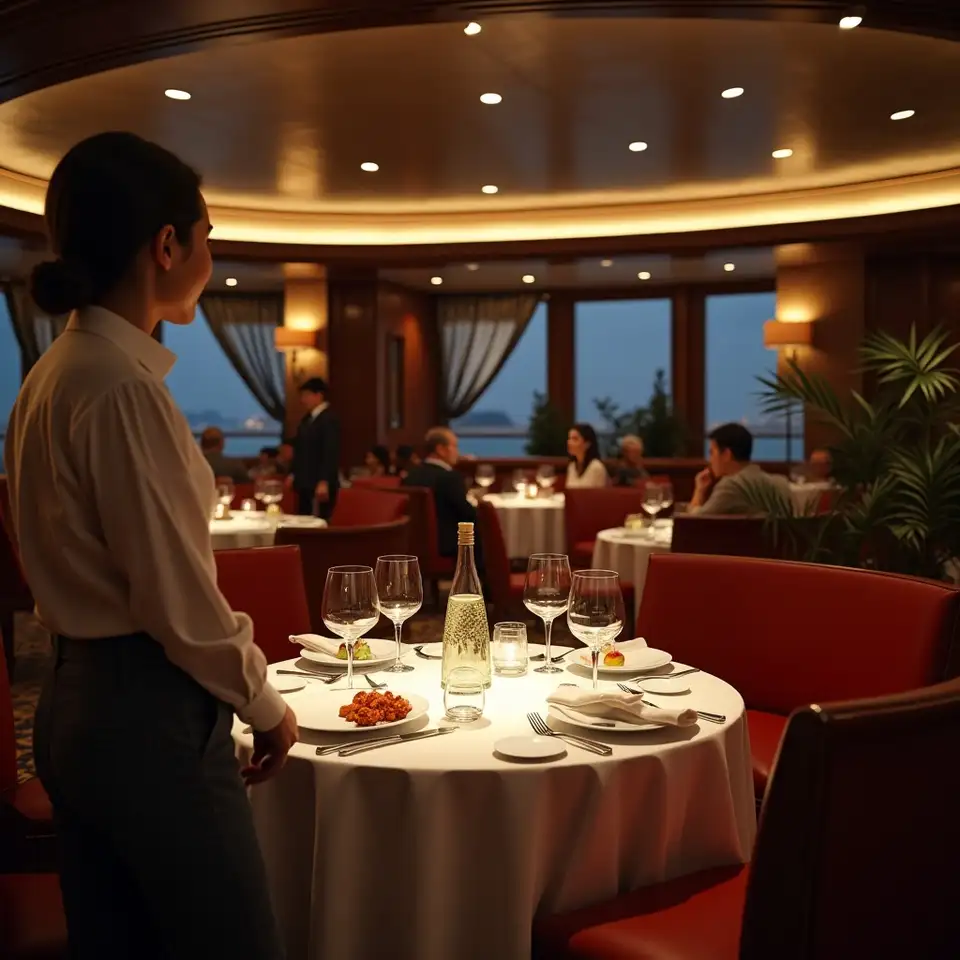
elegant specialty restaurant interior on a cruise ship with well-dressed diners

Understanding the dining structure on board before you sail helps you plan your meals and your budget with confidence.

Food is one of the most consistently discussed aspects of any cruise voyage, and for good reason — the quality, variety, and structure of dining options shapes daily life on board more than almost any other single factor. Most cruise fares include access to the main dining room and the buffet restaurant at no additional cost. These venues serve breakfast, lunch, and dinner across defined service windows, with menus that rotate across the voyage to prevent repetition.

Specialty restaurants — which typically operate alongside the included venues — charge a cover fee per visit or a fixed fee per person. These venues offer a more intimate setting, longer service windows, and menus that go beyond what the main dining room provides. For a seven-night voyage, most experienced cruisers find that two or three specialty dining evenings strike the right balance between variety and cost.

Beverage packages, available as add-ons at the time of booking or on board, cover a defined range of drinks across the voyage for a fixed daily rate. Whether a package represents value depends on your actual consumption habits — a traveller who drinks one coffee, two soft drinks, and a glass of wine with dinner each day may find the package cost-neutral at best. Running a realistic daily estimate before purchasing is more useful than accepting the package automatically.

Dietary requirements and food allergies are accommodated on virtually every major cruise line, but the process works best when requirements are declared at the time of booking rather than on board. Most cruise lines maintain a dedicated dietary needs team that coordinates with galley staff across all dining venues for the duration of your voyage. Declaring requirements early — whether gluten intolerance, a nut allergy, vegetarian or vegan preference, or a medically prescribed diet — ensures the kitchen team is prepared before you board rather than adapting reactively once you are already at sea. Kosher and halal dining options are available on some cruise lines and routes; availability varies and should be confirmed at the booking stage. For Malaysian travellers with halal dietary requirements, this is a practical checkpoint worth addressing early in the planning process, as the answer differs meaningfully between cruise lines and specific ships within the same fleet.

Cruise Etiquette

Cruise ships bring together a large number of people from different backgrounds into shared spaces for an extended period. The social contract that makes this work smoothly is largely informal — a set of practices that experienced cruisers observe without being asked and that first-time passengers benefit from understanding before they board. First, pool deck etiquette. Reserving sun loungers with towels and then leaving them unoccupied for extended periods is the most reliably cited source of friction on cruise ships across every category and price point. Most cruise lines have policies discouraging the practice, and some actively enforce them by removing towels from unoccupied chairs after a defined period. The practical approach is to arrive at the pool deck when you intend to use it, rather than claiming a position hours in advance. Next, dining room timing. Main dining rooms operate across specific service windows, and arriving significantly after the closing time creates pressure on kitchen and service staff who are preparing for the next meal period. If your schedule on a port day runs late, the buffet restaurant typically offers more flexible hours and is the appropriate choice for a late return from shore. In shared corridors and elevator lobbies, noise levels matter more than they might in a hotel, because cabin walls on cruise ships transmit sound more readily than purpose-built accommodation. Late-night corridor conversations and early-morning cabin door activity are the two most common sources of noise complaints on board. Awareness of this tends to resolve the issue entirely. Regarding dress codes: they exist for a reason, and the appropriate response is to check your specific ship's policy rather than to assume that any standard applies universally. Contemporary cruise lines have relaxed their evening standards considerably over the past decade, but premium and luxury lines still maintain expectations that are worth understanding before you pack. Arriving underdressed for a formal evening in the main dining room is avoidable with five minutes of advance research. Finally, gratuities. On cruise lines where gratuities are not included in the fare, a daily service charge is typically applied to your onboard account automatically. This charge distributes across cabin stewards, dining room staff, and other crew members who contribute to your experience throughout the voyage. Removing or reducing this charge without cause creates a direct impact on the crew members it was intended to reach. If a specific service issue warrants discussion, guest services is the appropriate channel — not a unilateral reduction in the automatic gratuity.
cruise passengers disembarking with luggage at a busy port terminal

First-Time Cruiser Guide: What No One Thinks to Tell You Before You Board

Your first cruise involves a specific set of surprises — some pleasant, some practical, and a few that are genuinely useful to know in advance. This guide covers the things that experienced cruisers wish someone had mentioned before their first voyage: how embarkation day actually works, what to expect when you find your cabin for the first time, how the onboard account system operates, and why the last evening of the voyage requires more organisation than it appears. None of this is complicated, but understanding the sequence in advance removes the small frictions that accumulate into unnecessary stress on what should be a relaxed and enjoyable experience from the moment you arrive at the port.

Embarkation day is the most logistically dense part of any cruise. You will move through port check-in, security screening, document verification, and cabin assignment across a process that can take between thirty minutes and two hours depending on the ship size, port infrastructure, and the time of day you arrive. Arriving during the early embarkation window — typically the first two hours after the port opens — generally produces the shortest queues and gives you the most time to explore the ship before it departs. Your cabin may not be ready immediately upon boarding; most ships ask passengers to explore public areas and the buffet restaurant while cabin stewards complete their preparations, with cabins typically accessible by early afternoon.
The onboard account is a cashless system in which all purchases — specialty dining, beverages, spa treatments, shore excursions, Wi-Fi packages, and any retail — are charged to a card linked to your cabin key. You register a credit or debit card at check-in, and the account settles automatically at the end of the voyage. Reviewing your onboard account balance at a self-service kiosk or through the ship's app every two to three days prevents the unpleasant experience of a large final bill with unclear individual charges. Guest services can resolve any disputed items before disembarkation, but this is considerably easier to address during the voyage than after you have left the ship.
The final evening of a cruise requires more preparation than any other night on board. Luggage placed outside your cabin door by the published deadline — typically eleven o'clock on the last evening — is collected and processed for disembarkation. This means packing everything except what you need for the final night and the following morning before dinner on the last day. Keeping a small overnight bag with your travel documents, morning clothing, and any valuables separate from your checked luggage prevents the situation of arriving at breakfast on disembarkation morning with nothing accessible except what is already in the hold of the port terminal.

Cruise Costs

Understanding what drives cruise pricing — and when to act on that understanding — is one of the most practically useful things a prospective cruiser can learn before beginning their search in earnest.

The key factors that determine what you will pay for any cruise voyage you consider

  • Base cabin fare and what it actually covers in practice: The headline cabin fare covers your accommodation, inter-port transport, and access to main dining venues and standard onboard entertainment. It does not cover beverages beyond basic water, juices, and tea or coffee at meal service, specialty restaurants, shore excursions, gratuities where not included, or any purchased services. Understanding the precise scope of the base fare for your chosen cruise line before comparing prices across alternatives is the essential first step.
  • Cabin category pricing tiers and the real comfort difference between them: Inside cabins, oceanview cabins, balcony cabins, and suite categories each carry a distinct price point and deliver a measurably different daily experience. The gap between an inside cabin and a balcony cabin is most significant on voyages with several consecutive sea days, where private outdoor space becomes a genuine quality-of-life factor rather than an occasional luxury. On shorter voyages or port-intensive itineraries, the inside cabin can represent excellent value.
  • Seasonal pricing cycles and when fares are most and least competitive: Cruise fares follow predictable seasonal patterns tied to demand. School holiday periods, festive season sailings, and popular shoulder-season departure windows command premium pricing. Early-season and late-season sailings in any given region typically offer the most competitive fares for equivalent cabin categories. Knowing the demand cycle for your preferred region allows you to align your travel dates with periods of lower pricing without sacrificing meaningful quality.
  • Early booking discounts versus last-minute availability and what each strategy involves: Booking a cruise six to twelve months ahead of departure typically secures the widest cabin category selection and access to early-booking promotional pricing, particularly for popular itineraries and peak departure dates. Last-minute availability does exist and occasionally offers competitive pricing on remaining cabin inventory, but it comes with reduced choice and the risk that the specific sailing you want is no longer available. Early booking is the lower-risk strategy for most travellers.
  • Package add-ons and when pre-purchasing them represents genuine value: Drink packages, specialty dining bundles, shore excursion credits, and Wi-Fi packages are frequently offered at a pre-purchase discount compared to onboard pricing. Whether they represent value depends entirely on how you intend to use them. A drink package makes financial sense for a traveller who consumes regularly throughout the day; it represents poor value for someone who drinks sparingly. Running a realistic daily estimate before purchasing any package is more useful than accepting the bundled offer automatically.
  • Group and solo traveller pricing structures — what changes and what to negotiate: Cruise pricing is built around double-occupancy cabin rates, which means solo travellers typically face a single supplement — an additional charge that compensates the cruise line for the unoccupied half of the cabin. Some cruise lines offer specific solo cabin categories on certain ships, which avoid this surcharge entirely. Groups of six or more travelling together may be eligible for group booking rates and complimentary cabin upgrades on some sailings — worth discussing directly with our team before confirming a group booking.

Total Cost Calculation

Calculating the true total cost of a cruise requires working through five distinct layers in sequence. Start with the base cabin fare for your chosen category and sailing date. Add the cost of any packages you intend to purchase — drink, dining, Wi-Fi — using realistic estimates of your actual consumption. Factor in gratuities if they are not included in your fare, calculated across the full number of nights. Estimate your daily discretionary spend in port: local transport, meals ashore, entrance fees, and shopping. Finally, add pre- and post-cruise costs — flights to and from the embarkation port if sailing internationally, port city hotel nights if your schedule requires an overnight, airport transfers, and travel insurance. The sum of these five layers is the figure you should use when comparing cruise options against each other and against other holiday formats. A cruise that appears to cost significantly more than an alternative land-based holiday on the base fare comparison may prove cost-competitive or better once the full picture is constructed honestly for both options.

Comparing Cruise Value Against Other Holiday Formats

The most useful comparison between a cruise and a land-based multi-destination holiday is a total-cost comparison, not a headline-price comparison. A cruise fare that bundles accommodation, inter-destination transport, and main meals across a seven-night itinerary covering four countries is structurally different from a self-arranged trip covering the same destinations via flights, hotels, and restaurant meals. Constructing both options on a full-cost basis — including every layer of expenditure — is the only honest way to determine which delivers better value for the experience it provides. In many cases, the cruise emerges as the more cost-efficient option once transport and accommodation costs across multiple destinations are aggregated for the alternative.

Six Practical Advantages of Cruising Over Other Travel Formats

For travellers weighing a cruise against other multi-destination holiday options, these six practical advantages consistently prove most relevant when the full picture of both formats is considered side by side.

Multi-destination

Bundled costs

Group-friendly

Unpack once across every destination on your itinerary

Practical

A seven-night cruise visiting four ports involves a single check-in, a single unpacking, and a single check-out. The equivalent land-based itinerary involves four hotel check-ins, four sets of luggage transfers, and the logistical overhead of coordinating transport between each destination. The reduction in daily administrative friction across a cruise voyage is one of its most consistently appreciated structural features, particularly for older travellers and families travelling with young children.

Transport between destinations included in the base fare

Cost

Inter-port transport on a cruise is built into the fare and requires no separate booking, payment, or planning. The ship moves overnight in most cases, meaning you arrive at the next destination refreshed rather than depleted by a transit day. Comparing this against the cost and complexity of flights or train connections between the equivalent land destinations illustrates the consolidation advantage clearly — particularly for itineraries covering multiple countries within a single voyage.

Main meals included without requiring advance restaurant reservations

Included

Main dining room access is included in virtually every standard cruise fare, covering breakfast, lunch, and dinner across defined service windows for the full duration of the voyage. There is no requirement to research, book, or budget for restaurants at each destination as you would on a self-arranged trip. For travellers who find the daily logistics of meal planning across multiple cities genuinely tiring, this structural simplicity is a meaningful quality-of-life improvement over the course of a ten-night itinerary.

Family group logistics simplified by a single shared base

Family

Coordinating accommodation, meals, and daily logistics for a multigenerational family group across multiple destinations is one of the more demanding aspects of self-arranged travel. A cruise resolves this by providing a single shared base that travels with the group. Children's programmes, family cabin configurations, and shared dining venues are all accessible from the same booking without additional coordination overhead. The group arrives at each destination together, from the same starting point, with the same return deadline.

Overnight transits preserve full days at each destination

Time

Most cruise itineraries are designed so that the ship travels between ports overnight, arriving at each new destination by early morning. This preserves the full daylight hours at every port stop without consuming a daytime travel period. A land-based itinerary covering the same number of destinations would typically require one or more full travel days that contribute nothing to the experience of the destinations themselves. The overnight transit structure is one of the most time-efficient aspects of cruise travel.

Onboard medical facilities provide a consistent safety baseline at sea

Safety

All commercial cruise ships of significant size are required to maintain onboard medical facilities staffed by qualified medical personnel. For travellers with ongoing health considerations, or those who feel more comfortable knowing that professional medical assistance is accessible throughout the voyage, this provision represents a meaningful practical advantage over self-arranged travel in regions where healthcare infrastructure varies significantly between destinations. Combined with appropriate cruise travel insurance, this baseline provides a sensible framework for managing health considerations at sea.

We Use Cookies on Faloxirenal

We Use Cookies on Faloxirenal

Faloxirenal.com uses cookies to keep the site functioning correctly, to understand how visitors navigate our cruise planning guides, and — where you consent — to deliver relevant content based on your browsing activity. We use four cookie categories: strictly necessary cookies that the site cannot function without, performance cookies that collect anonymised usage data, functionality cookies that remember your preferences, and targeting cookies that support relevant content delivery on other sites you visit. You may accept all categories, decline non-essential cookies, or adjust your preferences individually at any time. Your strictly necessary cookies will remain active regardless of your choice.

Faloxirenal.com uses cookies to keep the site functioning correctly, to understand how visitors navigate our cruise planning guides, and — where you consent — to deliver relevant content based on your browsing activity. We use four cookie categories: strictly necessary cookies that the site cannot function without, performance cookies that collect anonymised usage data, functionality cookies that remember your preferences, and targeting cookies that support relevant content delivery on other sites you visit. You may accept all categories, decline non-essential cookies, or adjust your preferences individually at any time. Your strictly necessary cookies will remain active regardless of your choice.

Strictly Necessary Cookies

These cookies are required for faloxirenal.world to function correctly. They manage your session, maintain secure connections, and enable the enquiry form to submit successfully. They are active at all times and cannot be disabled through this panel. No personal data collected by these cookies is used for marketing or shared with third parties for commercial purposes.

Performance and Analytics

These cookies collect anonymised data about how visitors move through faloxirenal.world — which cruise planning pages are visited most frequently, how long visitors spend on each page, and where technical errors occur. This information helps us improve the structure and content of the site. No individual user is identified by this data. You may decline these cookies without affecting your access to any part of the site.

Functionality Cookies

These cookies remember preferences you set during your visit to faloxirenal.world, such as your preferred cruise region or voyage type, so the site behaves consistently when you return. Declining these cookies means your preferences will not be retained between sessions and you may need to reapply them on each visit.

Targeting Cookies

These cookies record your visit to faloxirenal.world and the pages you browsed. This information may be shared with advertising networks to enable cruise-related content to appear on other websites you visit subsequently. We do not use these cookies to build profiles for sale to data brokers. You may decline these cookies at any time without affecting your ability to use faloxirenal.world.